The announcement of John the Baptist in Luke 3
This Dominicus's gospel lectionary reading for Advent two in Year C is Luke three.i–6, the location and opening of John the Baptist'southward ministry. We will hear more most the content of John'southward ministry building adjacent week; for at present, nosotros are only given the setting.
During the last year, we take got used to reading Mark by looking at the narrative shape of what he says, and the way he does his Christology and makes his theological points by his system of his fabric. I am get-go to feel that, returning to Luke, we will demand to be alarm to this even more. As many commentators now note, Luke appears to exist making a deliberate effort to meet the criteria for what was expected of skilful historiography in his 24-hour interval, and this is shown in his sometimes complex and subtle arrangement of material. This calendar week's reading is a good example.
There are several interesting things to annotation about the opening list of rulers in Luke 3.ane. This is not the start fourth dimension that Luke has located his story in the context of the wider globe. After his short prologue outlining his purposes and method, he introduces us to Zechariah 'in the days of Herod [the Slap-up] king of Judea'. The nativity of Jesus is gear up in Luke 2.ane at the time of 'Caesar Augustus' who issued a census, and Luke farther qualifies that this is the 'first [of importance?] when Quirinius was governor of Syria'. Despite our defoliation about what Luke means here, he appears to be wanting to locate the events he narrates with some precision.
The much longer list does a number of things. Near manifestly, information technology tells u.s.a. that fourth dimension has moved on; Herod the Great has died, and Luke mentions ii of his iii sons who succeeded him (omitting mention here of Herod Archelaus, who was removed past the Romans, and Pilate now governs what has become the Roman Province of Judea). In fact, it allows the states to date the ministry of John with some accuracy; the fifteenth year of the reign of Tiberius would exist 28 or 29, depending on the exact time of year. This is a remarkable thing to know about someone who is an apocalyptic prophet in an obscure corner of the Roman Empire; we know this only from Luke'due south gospel, just it correlates perfectly with other information we have well-nigh dating the events of the gospels and Acts.
The 2d affair this list does is illustrate Luke's concern for historiographical accuracy. Although some English translations obscure information technology, Luke is careful to use the correct titles for each of the rules, then Pilate is 'governor' whilst Herod, Philip and Lysanias are 'tetrarchs' ruling parts of Herod the Great'due south domain after it was divided upwards. A archetype text exploring the historicity of the New Testament was F F Bruce's The New Testament Documents: are they reliable? (I have the 1960 5th edition reprinting which I bought in 1980) which y'all tin can read online. Bruce notes:
Whatever his sources were, Luke made good use of them. And he sets his story in the context of purple history. Of all the New Testament writers, he is the but one who so much as names a Roman emperor. Three emperors (Augustus, Tiberius, and Claudius) are mentioned past name; the Emperor Nero is besides referred to, but not past his personal proper name—he is the 'Caesar' to whom Paul appealed. The birth of Jesus is fixed in the reign of the Emperor Augustus, when Herod the Great was king of Judaea, at the time of an imperial demography. The commencement of the public ministry building of John the Baptist, with which the 'Kerygma' proper begins, elaborately dated by a series of synchronisms in the Greek historical style, reminding the classical student of the synchronisms with which, for example, Thucydides dates the formal outbreak of the Peloponnesian War in the beginning of the second book of his History.
Names of note in the Jewish and Gentile world of his day appear in Luke'southward pages; in addition to the emperors, we meet the Roman governors Quirinius, Pilate, Sergius Paullus, Gallio, Felix, and Festus; Herod the Great and some of his descendants—Herod Antipas the tetrarch of Galilee, the vassal kings Herod Agrippa I and II, Berenice and Drusilla; leading members of the Jewish priestly degree such as Annas, Caiaphas, and Ananias; Gamaliel, the greatest gimmicky Rabbi and Pharisaic leader. A writer who thus relates his story to the wider context of world history is courting trouble if he is not conscientious; he affords his critical readers then many opportunities for testing his accuracy. Luke takes this chance, and stands the test admirably. I of the virtually remarkable tokens of his accuracy is his certain familiarity with the proper titles of all the notable persons who are mentioned in his pages. This was by no means such an easy feat in his days as it is in ours, when it is so simple to consult convenient books of reference.
Bruce goes on to list the correct names that Luke uses throughout Acts—including those that modify at particular times, so Luke would need to know the exact timing and changes to record them accurately, which he always does.
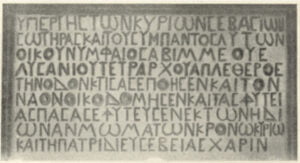 At that place are two questions almost the inclusion of Lysanias. The first is whether Luke was in mistake, since Josephus mentions a person by that name from a much before period—just the accuracy of Luke's reference was confirmed by the discovery of an inscription in the nineteenth century that mentioned a 'tetrarch Lysanias' (the outset 2 words on the 4th line in the image on the right) in the correct period.
The 2d is why Luke includes him at all? He is an otherwise insignificant effigy, and the pocket-size territory he ruled over is not meaning in the gospels, and doesn't really complete a systematic geographical clarification. I take not plant an explanation in commentaries, simply I would like to suggest a solution in the light of Luke's interest in numerical composition, which is evident in other places in the gospel and Acts: Luke here offers us a list of seven names, and then in some sense is describing a 'complete' historical location for John'south ministry. Four of these 7 (Pilate, Herod Antipas, Annas and Caiaphas) play of import parts in the narrative that follows.
Although the chief office of this list focuses on the 'secular' power of rulers, he completes it with mention of the two high priests; into the international scene of political and armed services power, he folds the national scene of 'religious' power. Annas was high priest from half dozen to 15, so past at present no longer holds office, but he was succeeded by his 5 sons, his son-in-law Joseph Caiaphas (from 18 to 36/37) and perhaps a grandson.
Annas had…virtually-dynastic command of the role…As the caput of the temple and its cult, Caiaphas and Annas would take exercised nigh unrivalled ability and privilege among the Jewish people (Joel Green, NICNT on Luke, p 169).
What would be the rhetorical affect of this introduction? I wonder how it would feel if we did something similar in introducing a local result?
At the time when Boris Johnson was Prime Government minister of Smashing Britain, when Joe Biden was President of the United States, 11 Jinping was President of the People'due south Republic of China, Nicola Sturgeon was First Government minister of Scotland, and Emmanuel Macron was the President of France, when Justin Welby and Stephen Cottrell were Archbishops of Canterbury and York, John Smith was appointed vicar of St Muggles in the Marsh.
At one level, at that place is a sense of absurd contrast between the large scale of the canvas on which the story is painted, and the quaint parochialism of the story itself. And yet at the same time it suggests that in that location is a connectedness betwixt the two; we might expect that John Smith is going to do something quite dramatic in order to merit this introduction. Information technology reminds me of the beginning of the Lord of the Rings, where on the i hand we are enlightened of the weighty history and centres of power represented past Minas Tirith and the state of Mordor—but then we suddenly find ourselves in the comparative humdrum of a birthday political party!
More than than that, we might begin to think most the implications of the context. The seven names I have included hint at the exit of the United kingdom from the EU, and the uncertainties that has brought; conflicts with France about line-fishing rights, trade, and migrants; questions about the Union and Scottish independence; the political tensions around Trumpism in the Usa; the growing threat of Communist china in trade, armed forces power, and cyber warfare; and closer to home the challenges facing the Church of England, and its disputes about mission, parishes, and church planting.
For Luke's readers, they volition be aware of the reign of Tiberius equally marked by his decline in mental health and the terror of his last years, including the expulsion of Jews from Rome. Pilate was known for his ruthlessness, a human being who was 'inflexible, a blend of cocky-volition and relentless', who held the Jews in low esteem, introducing tokens of emperor worship into the temple at Jerusalem and taking money from the temple treasury. Herod Antipas built his Hellenized capital, Tiberias, on a graveyard, which would be unclean for Jews, placed images in public places, and was fiercely loyal to Rome. Philip reigned in a Gentile area, in which he accelerated Hellenization.
Luke's synchronism in Luke 3.one–2a provides, therefore, more than an historical setting for or local colour to the narrative. Rather, they betoken a detail, tension-filled, top-heavy, socio-historical milieu (Green, ibid).
Into this context of power, threat, and instability, 'the discussion of the Lord' comes to John. This is the language of the Onetime Testament patriarchs, kings, and (especially) prophets: the give-and-take of the Lord comes to Abraham (Gen 15.1); Samuel (1 Sam 15.10); Nathan (2 Sam 7.4); Solomon (1 Kings vi.11); Elijah (ane Kings 17.2); Isaiah (Is 38.iv); Jeremiah (Jer 1.4 and 22 times more!); Ezekiel (Ezek one.iii)—well, you get the idea! The phrase comes 98 times in the OT, only Luke lonely uses information technology in relation to John the Baptist. And we find a similar mention of geo-political markers juxtaposed with the coming of the 'word of the Lord' in many prophets (encounter Is i.one, Jer 1.2–iii, Joe 1.1). Into a scene of power, disharmonize, and oppression, God speaks his give-and-take and announces the coming of the promised male monarch.
John is introduced both in terms that remind us of the preceding chapters, taking us back beyond the strong sense of introduction in these opening verses dorsum to the training that God has fabricated ('son of Zechariah', again unique to Luke). The mention of his being 'in the wilderness' also connects u.s. with where we left him in Luke 1.eighty, but, forth with mention of the Hashemite kingdom of jordan, points farther back to the Exodus wanderings and entrance into the promised land.
Luke agrees with Mark'due south phraseology in describing his bulletin every bit 'preaching a baptism of repentance for the forgiveness of sins'. Similar the prophets of old, John is preparing the people for the imminent eschatological coming of God to his people in both liberation and judgement.
And you, my kid, will be called a prophet of the Well-nigh High; for you will go on before the Lord to prepare the mode for him,to give his people the cognition of salvation through the forgiveness of their sins… (Luke 1.76–77).
The thought of baptism, administered by a third party, appears to be novel. Gentile converts to Judaism (proselytes) had to undergo a ritual washing as part of their initiation, but this signified a change of ethnic affiliation, and hither John is baptising Jews who remain Jews. Ritual washing in themiqveh was practised at Qumran and in connection with the temple, but only began around this time, was self-administered, and was a repeated activeness where John is offering a once-for-all action in preparation for the coming of God.
But in that location is a sense in which the people of God are very familiar with the idea of passing through water equally preparation for the activeness of God. They passed through the waters of the Red Sea as preparation for journeying in the wilderness (hence Paul's language of 'baptism in Moses' in 1 Cor 10.2); they and so passed through the waters of the Jordan to enter the Promised Land; the psalmist is rescued through the deep waters of death by God (eg in Ps 18.16); and in returning from exile God has rescued them as they 'laissez passer through the waters' (Is 43.2). This multiple significance was captured rather nicely in the prayer over the water in the ASB 1980 Baptism service (sadly emaciated in the Common Worship service).
John's baptism is offered as a sign of 'repentance', of turning back to the way of God after having strayed, and anticipates Jesus' own preaching almost the correct response to the kingdom. (It is often suggested that the Greek termmetanoia has a sense of 'thinking again' because of its etymology, but words do not always hateful what their etymology suggests, and it is a synonym of the verb ( epi)strephowhich in the Seventy translatesshuv significant a literal or metaphorical turning around and changing direction.)
Through submitting to repentance-baptism, in which their roles were passive, they signified their give up to God's aim, distanced themselves from by ways of life oriented away from God's purpose, and professed their renewed allegiance to his will. By coming out into the wilderness to meet John they symbolized that separation from ordinary life, through baptism embraced a conversion of loyalties and were themselves embraced into it the community of God'south people, and by returning to their everyday lives they accepted the vocation to reflect behaviours apropos true children of Abraham (Green, NICNT, p 165).
The citation of Isaiah 40.3–5 is fuller than Matthew's cursory citation, and more disciplined that Mark, who combines Isaiah with Malachi. (It is interesting that Luke describes it as 'the book of the words of Isaiah the prophet', avoiding contemporary issues of authorship!) The citation brings together the themes of preparation for God's coming and judgement in the desert identify, so this continues Luke'southward themes rather than being a biblical aside; he has already provided the bear witness which correlates the words of Isaiah with the actions of John.
Although the Christological claims implicit here are slightly more muted than in Marker, they are still nowadays, as they take been from the outset of Luke: the Lord, Yahweh, Israel's God who comes to his people, arrives in the person of Jesus for whom John is making preparation.
There is a powerful parallelism between 'mount/made low', 'crooked/straight', 'crude/smooth' and 'people/salvation'. The mighty will be brought down from their thrones, the crooked powers will be straightened, and the challenging times will be made endurable, when God'due south conservancy comes. Crooked and sinful people, within and without Israel, will have the offer of forgiveness and salvation held out to them, in ways they cannot yet imagine. There is an inclusio betwixt the mention of Caesar in poesy one and 'all flesh' in verse 6, an inclusio that shapes the whole of Luke'due south account which ends in Acts 28 with the good news of the kingdom being preached by Paul to all—in Rome, the center of the empire at whose fringes this activity begins.
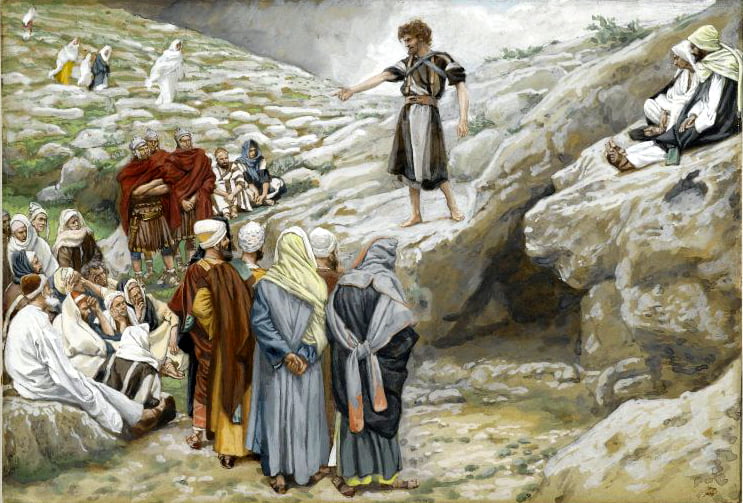
The picture at the top is John the Baptist in the Wilderness, held at the Brooklyn Museum in New York, past the French nineteenth-century artist James Tissot. One of the reasons I like information technology is that John looks like a 1970s rock star…
If y'all enjoyed this, do share it on social media (Facebook or Twitter) using the buttons on the left. Follow me on Twitter @psephizo. Like my folio on Facebook.
Much of my piece of work is done on a freelance footing. If y'all have valued this mail service, you tin make a unmarried or repeat donation through PayPal:
Comments policy: Skillful comments that appoint with the content of the mail service, and share in respectful debate, can add together real value. Seek commencement to understand, then to be understood. Make the nigh charitable construal of the views of others and seek to learn from their perspectives. Don't view debate as a conflict to win; address the argument rather than tackling the person.
Source: https://www.psephizo.com/biblical-studies/the-announcement-of-john-the-baptist-in-luke-3/

Post a Comment for "The announcement of John the Baptist in Luke 3"