How to Read a Culture and Sensitivity Report
Originally adult by Milton Bennett in 1986, and updated multiple times since, the Developmental Model of Intercultural Sensitivity is 1 of the more than influential models in the fields of intercultural communication, engagement, and equity. Sometimes chosen the "Bennett Calibration," the model describes the standard ways in which people experience, interpret, and interact across cultural differences, and it proposes a developmental continuum forth which people can progress toward a deeper understanding and appreciation of cultural variance, as well as greater social facility when negotiating cross-cultural dissimilarity. Bennett founded the Intercultural Evolution Research Institute to support related enquiry and practical applications of the model.
The Developmental Model of Intercultural Sensitivity is based on decades of academic research and on formal observations of cross-cultural dynamics in schools, communities, and organizations. Co-ordinate to Bennett, "Equally ane's perceptual organization of cultural divergence becomes more complex, one's experience of culture becomes more sophisticated and the potential for exercising competence in intercultural relations increases. By recognizing how cultural deviation is being experienced, predictions about the effectiveness of intercultural communication can be fabricated and educational interventions can be tailored to facilitate development forth the continuum."
"The basic mechanism for internalizing (embodying) worldview is perception . Following Piaget, Vygotsky, and other developmentalists, children become more than adaptive to their particular circumstances past elaborating perceptual categories of relevant things while leaving irrelevant things either unperceived or merely vaguely categorized. For example, pasta is a relevant category for Italian kids, and many of them already know the shapes (e.g., penne or rigatoni) that go with different sauces. Pasta is not very relevant for American kids, and near of them tin can only use the undifferentiated category of "macaroni." Writ large, culture provides us with a set of these kind of figure/ground distinctions that let u.s.a. to co-construct with our compatriots the unique adaptive processes of our group…. As a issue, otherness exists in a broad and vaguely defined perceptual category, like macaroni for pasta. Such a perceptual condition is inadequate for communicating effectively with cultural outsiders, since it lumps together people of different cultures inappropriately and precludes taking their unique perspectives in whatsoever meaningful mode."
Milton Bennett, "Developmental Model of Intercultural Sensitivity," International Encyclopedia of Intercultural Communication
In 2004, Bennett explained his rationale for developing the model: "After years of observing all kinds of people dealing (or not) with cross-cultural situations, I decided to attempt to make sense of what was happening to them. I wanted to explain why some people seemed to get a lot better at communicating across cultural boundaries while other people didn't amend at all, and I thought that if I were able to explicate why this happened, trainers and educators could do a ameliorate job of preparing people for cross-cultural encounters." In role due to Bennett'due south emphasis on the educational applications of the continuum, the Developmental Model of Intercultural Sensitivity has been being widely used and adapted by practitioners working in fields as varied every bit parent and youth engagement, deliberative dialogue, racial equity, and organizational diversity.
The Developmental Model of Intercultural Sensitivity
The Developmental Model of Intercultural Sensitivity describes six developmental stages of intercultural sensitivity and advice, beginning with denial (the perception that i's cultural perspective is the only real, authentic, or valid interpretation of reality) and culminating with integration (the internalization of multicultural awareness and the ability to collaborate productively beyond cultural differences).
It is of import to notation that the stages of intercultural sensitivity described in the model use to individuals, groups, and organizations (although, as Bennett has noted, unlike approaches to evaluating or measuring developmental progress are required for different applications).
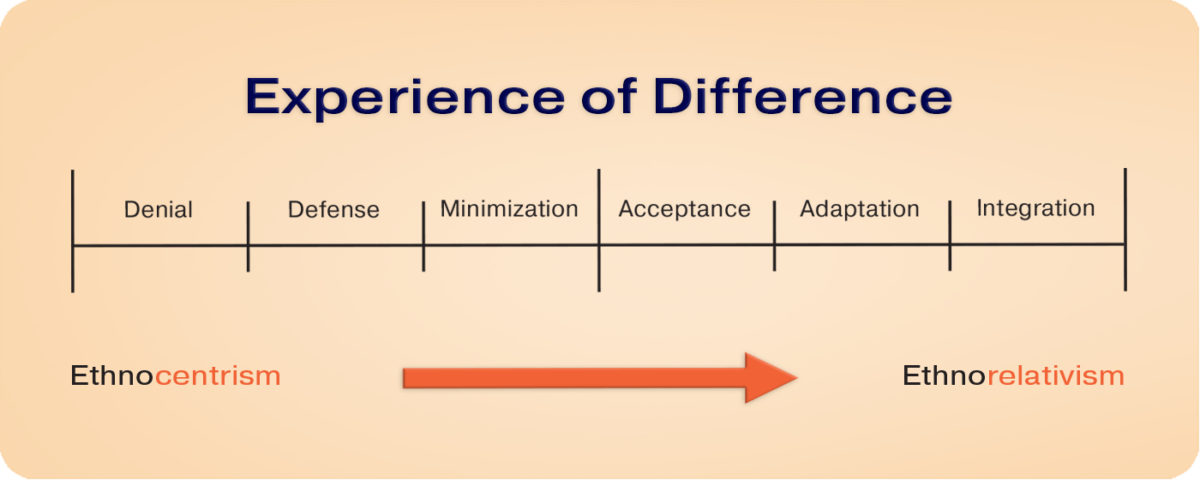
The continuum describes two distinct orientations toward cultural difference: ethnocentrism and ethnorelativism . In 2004, Bennett explained the development of the terms:
"As people became more interculturally competent it seemed that there was a major alter in the quality of their feel, which I called the motility from ethnocentrism to ethnorelativism. I used the term 'ethnocentrism' to refer to the experience of one's ain culture as 'central to reality.' By this I mean that the beliefs and behaviors that people receive in their primary socialization are unquestioned; they are experienced as 'only the way things are.' I coined the term 'ethnorelativism' to mean the opposite of ethnocentrism—the experience of one'south own beliefs and behaviors as just 1 organisation of reality among many feasible possibilities…. In general, the more ethnocentric orientations can be seen as ways of fugitive cultural difference, either by denying its being, by raising defenses confronting it, or by minimizing its importance. The more ethnorelative worldviews are ways of seeking cultural departure, either by accepting its importance, by adapting perspective to have it into business relationship, or by integrating the whole concept into a definition of identity."
The six developmental stages of intercultural advice and sensitivity:
1. Denial
Denial of cultural difference occurs when people fail to recognize distinctions amongst cultures or consider them to be irrelevant; when they refuse the merits that cultural differences exist or that they tin be meaningful and consequential; or when they perceive people from dissimilar cultures in simplistic, undifferentiated, and oft self-serving means. For example, people in the denial stage will lump other cultures into vague homogenized categories, such equally "foreigner," "immigrant," or "Asian," or they will stereotype, demean, or dehumanize others by assuming that different cultural dispositions must be the consequence of deficiencies in grapheme, intelligence, physical ability, work ethic, or other innate traits.
Denial may also manifest as a disinterest in or avoidance of other cultures, or in naive statements such as "Do they have toilets in Africa?" In educational settings, the denial stage may manifest in statements such as "Those families just don't value education" or "If they really cared well-nigh their children they would show upward to more schoolhouse events." In many cases, people at the denial stage are not intentionally trying to denigrate other cultures or groups, but their naiveté may nevertheless be hurtful to others or incline them to support unjust policies. They perceive others equally less circuitous than themselves, and thus they experience them as less human.
2. Defense
Defence against cultural departure occurs when people perceive other cultures in polarized, competitive, aught-sum, or usa-against-them terms (e.g., immigrants are taking our jobs, our traditional values are under assault, etc.); when they exalt their own culture over the culture of others (east.g., white nationalism); or when they feel victimized or attacked in discussions about bias, discrimination, or racism (e.g., they withdraw, exit the room, break downwardly in tears, get defensive or hostile, etc.). Defense may too manifest in efforts to deny people from other cultures equal access or opportunity, such as opposition to affirmative-action policies or diversity-hiring initiatives.
In educational settings, the defense stage may manifest equally parent protests or customs opposition campaigns against racial integration, out-of-commune busing, equitable school funding, or detracking (the emptying of academic tracks such as standard, college prep, and honors), or as the expressed fear that greater racial variety in the pupil population will inevitably atomic number 82 to more in-schoolhouse behavioral problems, drug corruption, and violence.
3. Minimization
Minimization of cultural difference occurs when people assume that their distinct cultural worldview is shared by others, when they perceive their culture'south values as fundamental or universal man values that use to anybody, or when people obscure, disregard, or neglect the importance of cultural differences (e.g., such as when organizational leaders respond—when confronted with examples of racial, indigenous, or gender bias in the workplace—with statements such as "We endeavor to treat anybody as" or "I don't run across color"). Minimization may also manifest in arguments that human similarities are more important than cultural differences (thereby implying that cultural differences are unimportant or that they tin can exist ignored), or in claims that "deep down humans are all akin."
Minimization may also manifest in arguments that human being similarities are more of import than cultural differences (thereby implying that cultural differences are unimportant or that they can be ignored), or in claims that "deep down humans are all alike."
Past reframing cultural differences in terms of human sameness, minimization enables people to avoid recognizing their own cultural biases, avoid the endeavour information technology would take to learn almost other cultures, or avoid undertaking the hard personal adaptations required to relate to or communicate more than respectfully across cultural differences. (The slogan "All Lives Matter," an antagonistic response to the Black Lives Matter move, is a quintessential example of minimization.)
In educational settings, examples of the minimization phase might include administrators discouraging blackness students from forming a black-educatee grouping by encouraging them to join an existing student grouping instead, or responding to incidents of racial bias and bullying amidst students by discussing the need for "respect" while avoiding directly discussions of racism. Another example would exist the so-called "food, flags, and fun" approach to multifariousness or multicultural teaching wherein educators celebrate superficial aspects of cultures, but avoid uncomfortable discussions about cultural differences or prejudice.
iv. Acceptance
Credence of cultural difference occurs when people recognize that unlike beliefs and values are shaped by culture, that different patterns of behavior exist among cultures, and that other cultures accept legitimate and worthwhile perspectives that should exist respected and valued. The acceptance stage may too manifest every bit greater marvel most or interest in other cultures, and people may start to seek out cantankerous-cultural relationships and social interactions that they might take avoided in the past.
In educational settings, acceptance may manifest in changes to the curriculum, such as teaching students about non-white historical figures or having them reading multicultural literature (rather than literature selected exclusively from the Western canon), or in programs such as LGBTQ+ student organizations that allow students to organize or brainwash their peers across cultural difference.
Chiefly, Bennett notes that acceptance does non crave that one prefer, hold with, or endorse the behaviors or values of other cultures; it means that one recognizes and accepts the fact that dissimilar cultural worldviews exist, that those worldviews shape man values, beliefs, and behaviors, and that 1's own values, behavior, and behaviors are in some mensurate culturally derived and adamant.
five. Adaptation
Adaptation to cultural difference occurs when people are able to adopt the perspective of another civilization, when they can empathize intellectually and emotionally with the experiences of others, or when they can interact in relaxed, authentic, and appropriate ways with people from different cultures.
The accommodation stage may also manifest when people from dissimilar cultural backgrounds tin talk over their cultural experiences and perspectives in ways that are conversant in and sensitive to the other culture (Bennett has described this process equally "common adaptation"), or when organizations embrace inclusive policies and practices that create atmospheric condition for respectful and productive cantankerous-cultural interaction and teamwork among employees.
Importantly, Bennett stresses that adaptation is not "absorption," which tin can be defined as the process of abandoning one's cultural identity to adopt a unlike cultural identity (most commonly the identity of the dominant culture). In fact, Bennett has written that "adaptation offers an alternative to assimilation. Adaptation involves the extension of your repertoire of behavior and beliefs, not a substitution of one set for another. So you don't need to lose your chief cultural identity to operate finer in a different cultural context."
6. Integration
Integration of cultural divergence occurs when someone's identity or sense of self evolves to incorporate the values, beliefs, perspectives, and behaviors of other cultures in appropriate and authentic means. As Bennett explains, "Integration of cultural deviation is the state in which i's experience of self is expanded to include the movement in and out of different cultural worldviews…. people are able to experience themselves every bit multicultural beings who are constantly choosing the most appropriate cultural context for their behavior."
The integration stage occurs nigh commonly among members of non-ascendant groups that are living in ascendant-group communities, expatriates who live for long periods of fourth dimension in other countries, and and so-called "global nomads" who spend their lives traveling and living in far-flung parts of the world.
In educational settings, integration is most likely to occur in schools that serve culturally various students and families, that are staffed with adults whose demographics mirror the diversity of the student and family population, and that teach a multicultural, and possibly even multilingual, curriculum that explicitly represents and integrates the varied cultural experiences and backgrounds of the customs.
Related Concepts
In his larger body of work, Bennett too describes and documents other phenomena that are important to understand how the developmental stages of intercultural sensitivity play out in social contexts, including the following two concepts:
Retreat
In most cases, the developmental progression of intercultural sensitivity is a ane-way phenomenon: every bit people prefer increasingly ethnorelative perspectives, they rarely fall back into ethnocentrism. Yet, Bennett describes a procedure he calls "retreat," which occurs when people movement from a higher ethnocentric stage to an earlier stage—most unremarkably from minimization to defense.
Retreat functions as a kind of "threat response": when people are confronted with cultural difference, or when they feel criticized or judged for their cultural views, a common reaction is to get defensive or lash out. In predominantly white organizations, for example, the culture and policies of the system, and the behaviors and comments of the white staff, may role in ways that minimize, or that are openly hostile to, the perspectives of people of color. When people of color then speak out nigh instances of bias in these settings, organizational leaders may deny that biased behavior exists or they may retaliate confronting those who spoke out with intimidation, harassment, promotion denials, or firing. In developmental terms, retreat from minimization to defense force commonly happens when individuals and groups struggle to accommodate different cultural ideas or expectations because insufficient acceptance has been established.
Reversal
"Reversal" or "defense reversal" occurs when people prefer the view that other cultures are superior to their own culture, such as when members of the dominant culture denigrate their own culture in the effort to secure approval, credence, or praise from minority groups. In Toward Multiculturalism: A Reader in Multicultural Education, Bennett offers the following useful description:
"Reversal may masquerade as cultural sensitivity, since it provides a positive experience of a different civilization along with seemingly belittling criticisms of 1's own culture. Even so, the positive experience of the other culture is at an unsophisticated stereotypical level, and the criticism of 1's own culture is commonly an internalization of others' negative stereotypes."
"Reversal in domestic multicultural relations is an interesting and complicated phenomenon. Information technology appears that some people of the dominant culture take on the cause of non-dominant cultures in stereotypical ways. For instance, in the U.S. a white person of European American ethnicity may go a rabid proponent of African American issues. While it is non necessarily ethnocentric for someone to identify with the plight of historically oppressed people, in this hypothetical case the European American person sees all black people equally saintly martyrs and all white people (including herself before the conversion) every bit brutal oppressors. Past irresolute the poles of the polarized worldview, this person has not changed her essentially unsophisticated experience of cultural departure."
Acknowledgments
Organizing Date thanks Milton Bennett for his contributions to improving this introduction, and the Intercultural Development Enquiry Institute for permission to reproduce images from its website.
References
EDITORIAL Annotation: Boosted reading virtually the Developmental Model of Intercultural Sensitivity can exist found on the Intercultural Evolution Research Institute website.
Bennett, Chiliad. J. (2017). Development model of intercultural sensitivity. In Kim, Y. (Ed.), International Encyclopedia of Intercultural Advice . Hoboken, NJ: John Wiley & Sons.
Bennett, M. J. (2004). Becoming interculturally competent. In J.South. Wurzel (Ed.), Toward Multiculturalism: A Reader in Multicultural Education. Newton, MA: Intercultural Resource Corporation.
Bennett, Thou. J. (1986). A developmental approach to training for intercultural sensitivity. International Periodical of Intercultural Relations , x(ii), 179–196.
Creative Commons

This work by Organizing Engagement is licensed under a Artistic Commons Attribution-NonCommercial-ShareAlike iv.0 International License. When excerpting, adapting, or republishing content from this resource, users should cite the source texts and confirm that all quotations and excerpts are accurately presented.
Source: https://organizingengagement.org/models/developmental-model-of-intercultural-sensitivity/

Post a Comment for "How to Read a Culture and Sensitivity Report"